Contact
partners@smithbox.com
Partners: 385.375.6772
Support: 801.448.0442
3248 N Canyon Rd
Suite 202
Provo, UT 84604
Suite 202
Provo, UT 84604


Custom jewelry does not fail because of price.
It fails because momentum is lost.
Not all at once.
Quietly.
Incrementally.
What begins as certainty becomes hesitation. What felt urgent becomes optional. The sale doesn’t collapse—it evaporates.
Speed is not an operational detail.
It is a conversion variable.
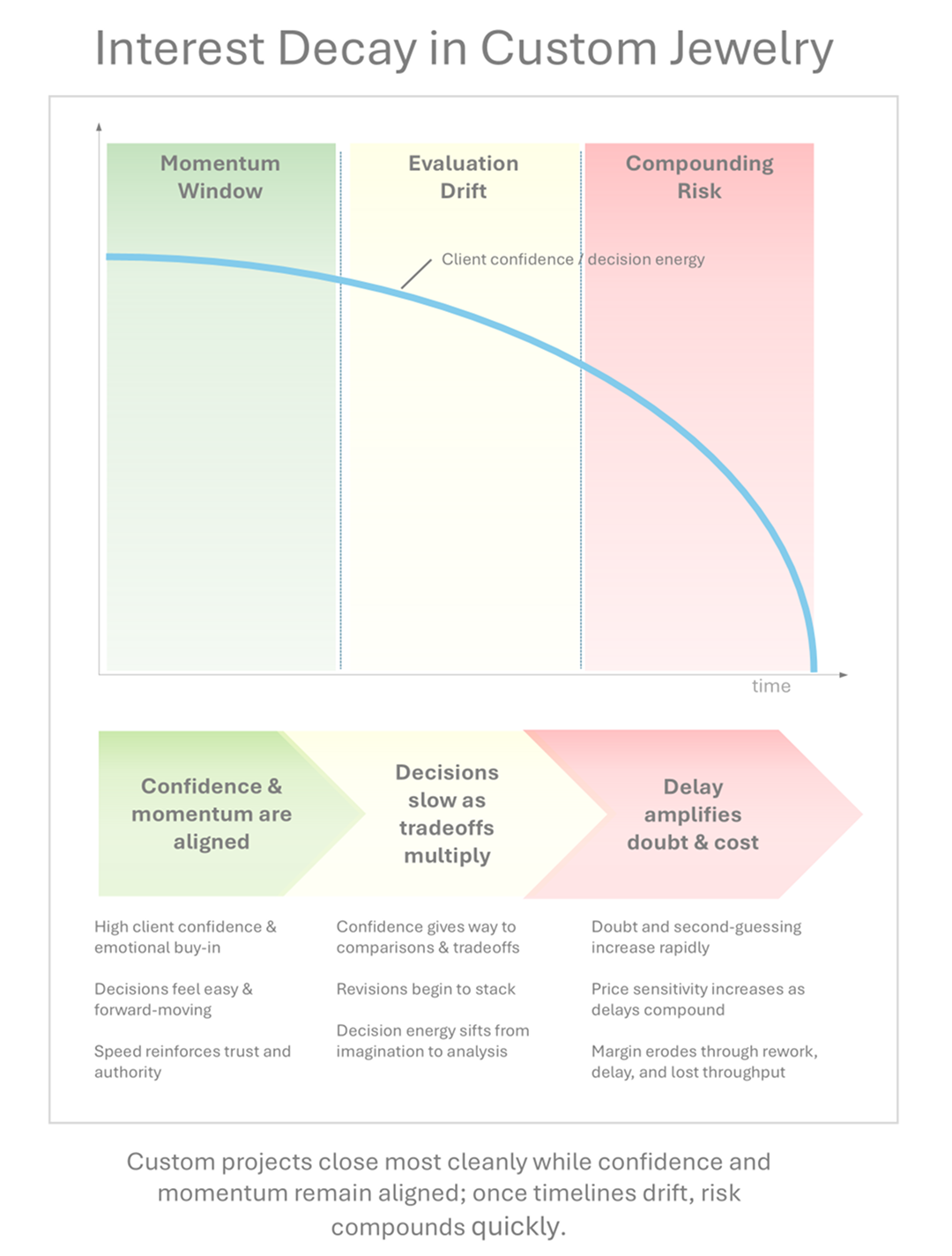
Every custom project begins inside a narrow emotional window.
The client is engaged.
They are imagining.
They are decisive.
This is when custom feels exciting rather than risky.
As time passes, the client’s mindset shifts. Imagination gives way to evaluation. Evaluation introduces tradeoffs. Tradeoffs slow decisions.
This shift is predictable—and preventable.
More revisions do not improve outcomes.
They weaken them.
Each additional revision:
By the third or fourth revision, the client is no longer choosing a ring.
They are managing a process.
That is not why they came to you.
Fast does not feel rushed when it is controlled.
It feels professional.
Clients associate speed with:
When answers are immediate and timelines are predictable, the jeweler feels larger and more credible—regardless of actual size.
Delay communicates fragmentation.
Speed communicates alignment.
Few phrases do more damage to momentum than:
“Let me check with my CAD designer.”
“Let me see what the caster says.”
“I’ll get back to you.”
Each one reminds the client that the system behind the sale is fragmented.
Momentum rarely survives that realization.
Once a project drifts outside the momentum window, risk compounds quickly:
The client hasn’t said no.
They’ve simply stopped moving forward.
At that point, closing the sale requires energy instead of inevitability.
Speed does not just close sales.
It:
In custom jewelry, velocity is not about rushing.
It is about staying inside the window where “yes” is still easy.
The jewelers who win at custom are not pushing clients faster.
They remove friction early, so momentum never has a chance to die.
