Contact
partners@smithbox.com
Partners: 385.375.6772
Support: 801.448.0442
3248 N Canyon Rd
Suite 202
Provo, UT 84604
Suite 202
Provo, UT 84604


Most independent jewelers believe they understand their costs.
They know what they pay their CAD designer.
They know what the casting house charges.
They know their bench jeweler’s hourly rate.
What they don’t see is the cost created in between.
This paper is about the Frankenstein Tax—the hidden operational penalty paid by jewelers who assemble custom production from disconnected, “best-price” vendors. On paper, this model looks flexible and efficient. In practice, it quietly consumes time, margin, and attention.
And most dangerously:
it feels normal.
The modern custom workflow is rarely designed.
It is assembled.
A freelance CAD vendor.
A separate casting house.
An in-house or contract bench jeweler.
Each specialist may be competent on their own.
The problem is not talent.
The problem is coordination.
Every handoff introduces ambiguity.
Every ambiguity requires clarification.
Every clarification costs time—and that cost is absorbed by the retailer.
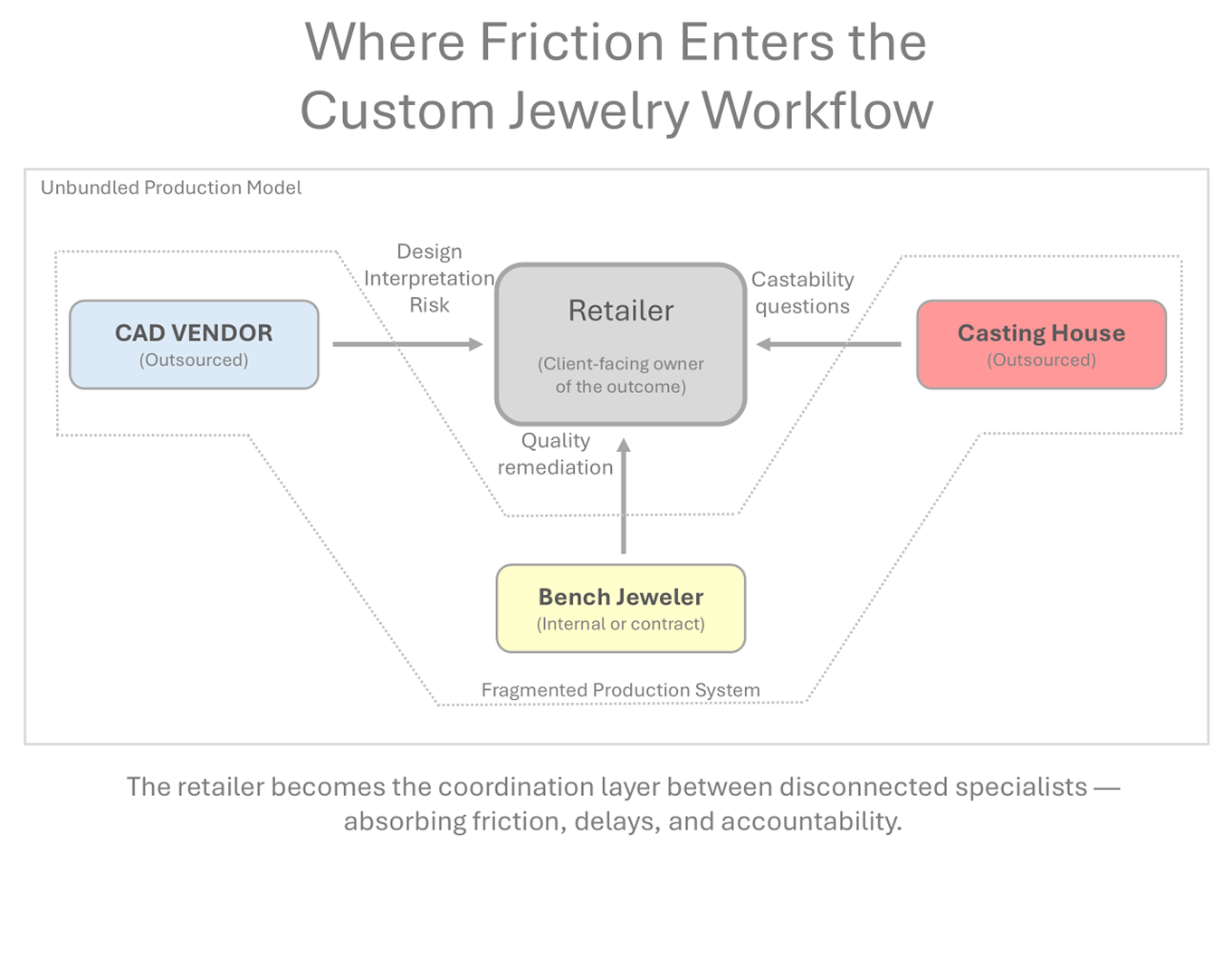
In an unbundled system, the retailer becomes the translator, mediator, and project manager.
Time is spent:
None of this appears on an invoice.
None of it is reflected in quoted margin.
But it is real labor.
This is the management tax—and it scales with every custom job you take on.
The second hidden cost of the unbundled model is late accountability.
When a piece comes back with porosity, thin shanks, or structural weakness, responsibility becomes unclear.
Was it the CAD file?
The casting process?
The bench execution?
By the time the question is answered, the retailer is already fixing the problem.
Bench time is consumed correcting issues that should never have existed. That labor is rarely billed back. It is absorbed quietly—oftenrationalized as “just part of custom.”
This is how theoretical margin begins to evaporate.
On paper, the unbundled model often looks attractive:
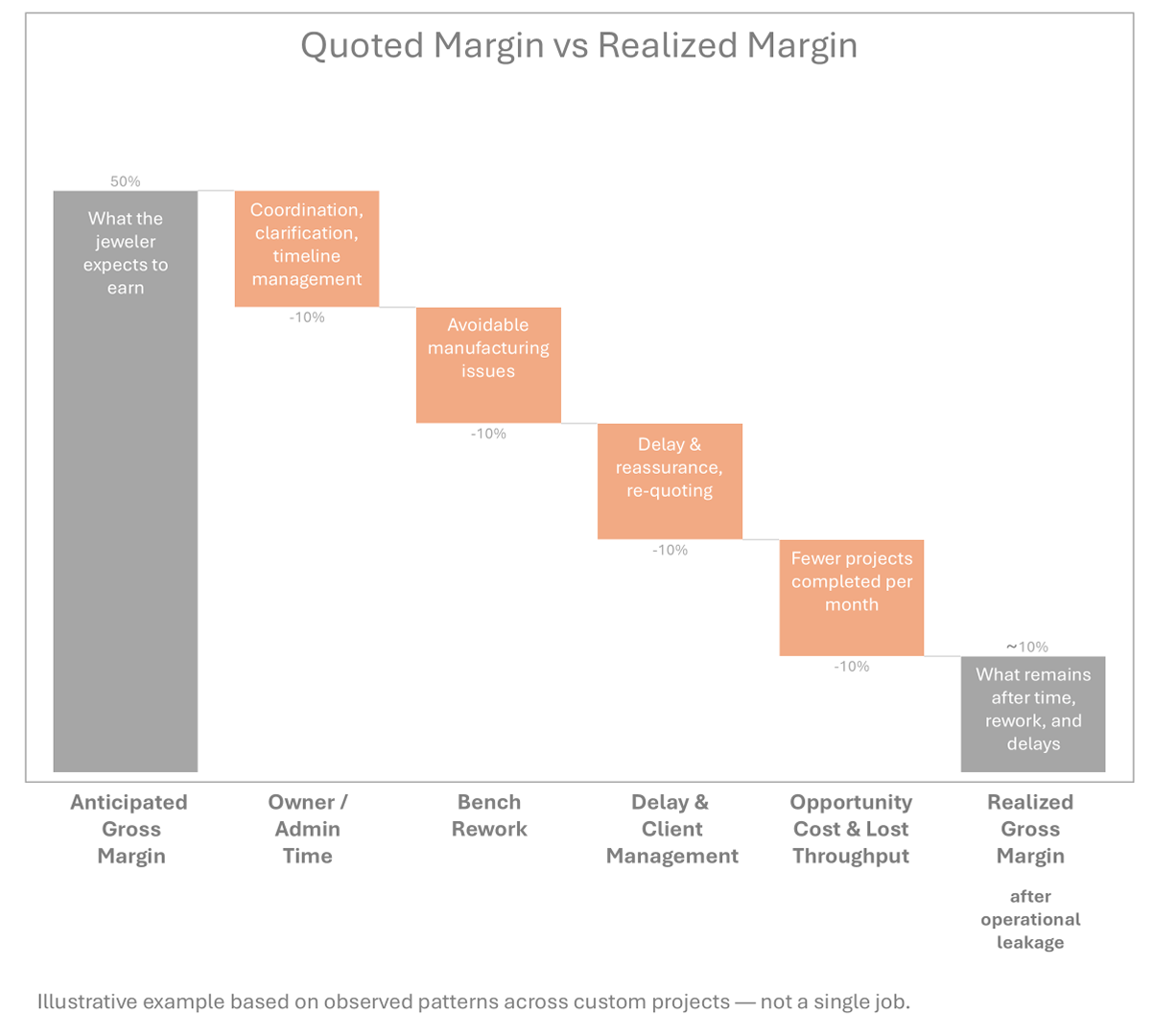
But quoted margin is not realized margin.
Once you account for:
The economics change dramatically.
A high-margin job on paper can become a low-margin—or marginal—job in practice once operational leakage is accounted for.
Time does more than delay delivery.
It magnifies every weakness in a fragmented system.
As timelines stretch:
Even when a job eventually closes, the cost of delay has already been paid—not on a receipt, but in time, focus, and lost capacity.
None of this requires incompetence.
The Frankenstein Tax appears even when:
It is not caused by bad actors.
It is caused by fragmented systems.
And because the retailer is the only constant across those systems, the cost accumulates there.
The unbundled production model became common because it was available—not because it was optimal.
Normal does not mean efficient.
Familiar does not mean profitable.
The most successful jewelers we work with did not change their craft.
They changed their infrastructure.
